
My sister, knowing, certainly, that I would not take the initiative to hunt them down myself, placed the entire stack in my hands when I visited her in Seattle this summer and instructed me to read them, although, she warned, they were like crack.
Yes, I scoffed, especially when I read the first page. It's possible I groaned, "It's even written in first person?"
However, it didn't take me too long to get past the frequently less-than-elegant writing style. It did distract me occasionally, especially in the first book (though I think her writing--or at least editing!--actually did improve in the subsequent volumes), but was quickly subsumed by the highly engaging story.
And the story is highly engaging. For anyone who has ever been a teenage girl--and for me, it's been a good decade since I could claim that distinction, and closer to 15 years since I was really in the throes of adolescent angst--it is also strongly emotionally resonant. Better yet, although I'm sure we can all remember the giddy highs and crushing lows of high school crushes, this is straight-up wish fulfillment: the crush object is not only beautiful, intriguing, and completely irresistible, he is, unlike any actual high school boy, a heady combination of not only masculinity and dangerousness, but intelligence, articulateness, sensitivity, restraint, and good manners.
Further upping his irresistibility quotient, he's ostensibly completely unattainable. But because we're in wish fulfillment mode (and, really, isn't that what fantasy is all about?), he is attained, and of course is even more perfect in that state than he was as simply an object to crave! What's a little stylistic roughness compared with sweet escapist reimagining of what teenhood might have been like in a world so kind to quiet, bookish, physically-disinclined girls?
New Moon, on the other hand, made me weep (see: crier). Who knew that my own feelings of abandonment, pain, and disintegration at male hands were still so fresh? Eeps. I found myself trying to hold myself together right along with Bella.
I won't go into the last two books, except to say again that I do think the series generally gets better as it goes along, thanks to improvement in skill or editing. They really are very fun, easy reads, and, as my sister warned, quite addictive.
My theory on why we love them is that they are so emotionally resonant. My theory on why we hate ourselves for loving them is that our emotions and desires are so predictable: even the strongest, best-educated, most enlightened feminists, it would seem, still want a strong, sensitive partner to want us more than anything, to treat us like it, and to say he'll be around forever.
So, yes, I guess I do love boys who sparkle. (David sent me that link yesterday because he thought it sounded like something I might enjoy. Yay, sparkly vampires!)
November 10, 2009
Stephanie Meyer, The Twilight Books
Richard Adams, Watership Down

I had a hard time getting into it, but did keep plugging along, and was rewarded for that. Although it's ostensibly a children's book, an an adventure at that, it sometimes seemed a bit mired down and slow. And long! Heavens! It was nearly 500 pages.
Still, it was at times quite engaging indeed. Surprisingly to me, it also provided some keen and interesting insights on the development of religion. And despite feeling generally less moved throughout the tale than I thought I might be, I was caught off-guard by the Epilogue, which completely sneaked up on me and make me cry. As I've mentioned before, I'm a crier.
July 16, 2009
Charles Frazier, Cold Mountain

Ostensibly a love story, albeit a nontraditional one, the tale is told in alternating chapters from the two protagonists' own concurrent, but not currently overlapping, lives. It is, at the same time, as much a love story to the land itself, with vivid descriptions of the south--and particularly the mountains of North Carolina. It was also original and enjoyable in its evocation of a bygone era through the language itself. I didn't, as it happens, look up any of the new words I encountered, but there were several--all descriptive of highly specific objects or actions--that I'd never come across before.
It also paints a vivid pictures of the struggle and reward of rustic farming, the horrors of the Civil War, and the power of the human spirit.
I'm finding it difficult to talk much about the book without spoilers, but I will say that I cried, and although I'm definitely a crier--especially, somehow, with books--it had been quite a while since one had gotten to me like this one did.
Highly recommended.
July 15, 2009
Dan Brown, Angels and Demons

Nonetheless, being the kind of person who reads the book before seeing the film (which almost without fail makes the film less enjoyable to me and me less enjoyable to other people), I had to read it first.
I read The Da Vinci Code several years ago, and although I thought the puzzles ridiculously simplistic to propel any sort of thriller, and the writing sorely lacking, I did find it highly engaging and devoured it in approximately 36 hours.
The same was not the case for Angels and Demons (although, in an attempt to make my timeline for a Wednesday evening movie date, I did read it in about three days). I found the first third or two offensively bad. The writing seemed blatantly terrible, and the plot refused to move to a degree that I could ignore it. Thankfully, somewhere between the second half and the final third, the action picked way up, and, like a reluctant sink hole, the book finally pulled me in. (Of course, it didn't swallow me whole; what on earth was with Langdon getting into--and for that matter, back out of--that helicopter? Complete inanity.)
The film was also bad, though it didn't take quite as many hours of my life and had the distinct advantage of being shot in Rome. There was even a bit of Italian, which placated me somewhat. Oh, and Ewan McGregor.
If you're curious what the hype is about, read The Da Vinci Code. (I haven't seen the movie, so I can't speak to it.) If you're a Ewan McGregor or Tom Hanks fan (I'm sort of the antithesis of the latter, most of the time), you can probably stomach Angels and Demons--but I wouldn't recommend reading the book first.
Ken Follet, The Pillars of The Earth

I finished the book in April, and am only just getting around to writing my review, but other than it being long, I mostly remember it as being not at well written, nonetheless highly engaging, and overall rather violent. It was rather like television, actually--perhaps an extended miniseries. It was highly descriptive, and certainly a page-turner, while still being almost unabashedly fluff. Almost, that is, because of its passages on Gothic architecture, which, although it's not my specialty, I at least found non-egregious if not particularly enlightening either.
Additionally, although the characters weren't always believable--the villains, in particular, being fairly consistently one-dimensional--the book did paint a fascinating portrait of life in the 12th century, and how much modern technology allows us to take for granted. Again, not precisely quality, but a quick-paced and interesting story that did get my heart pounding at times.
March 21, 2009
Virginia Woolf, Mrs. Dalloway

The omniscient perspective, it has always seemed to me, is a tricky voice to pull off in a novel, but Woolf handles it with aplomb. And, wow, if I thought The Manticore was hypermetacognitive, this one easily beats it, despite the former's use of psychoanalytical terminology, by sheer numbers of those cogitating.
It's a short novel, but neither compact nor concise; I found it took much longer and demanded more concentration than anything else I'd read recently. It was accordingly also somewhat tiring, because of its intricate descriptions, meandering sentences, and a nagging sensation (at least for me) that something very bad was going to happen. Still, its understanding and depiction of depression, madness, and the relationships between men and women were fascinating, and perhaps more so given its location in a very specific time and place. I don't have a desire to return to it any time soon, but am very glad to have read it and to have experienced the Woolf.
February 28, 2009
Robertson Davies, The Manticore
 Some books are staggeringly brilliant, whether because of their esoteric subject matter, intricately conceived plots, mind-blowing vocabulary, or depth of (often obscure) knowledge; Umberto Eco, Vladimir Nabakov, and Thomas Pynchon come to mind. I had not even heard of the Canadian Robertson Davies until my dad gave me The Manticore for Christmas this year, having selected him from the list of 100 20th century authors who didn't make the Lifetime Reading Plan proper (a book I had given him several years ago).
I don't think I would call this novel staggeringly brilliant; because of its general accessibility, its brilliance is less overt, sneaking up on you slowly. It's there, though, particularly in its superb metacognition, which manages to avoid the perils of complete self-absorption.
In the loosest of definitions, the novel could be called a murder mystery, but it takes the form primarily of Jungian psychoanalysis. Perhaps surprisingly, the two complement each other very well in a careful balance, the plot driving the exploration of self and characters and vice versa. Because I am a sucker for explorations of the psyche--and had never encountered a similar book!--I thoroughly enjoyed it. It's part of a trilogy, and although it stood well alone, I may check out the other two books after working through the rest of my Christmas reading.
February 19, 2009
Kate Walbert, The Gardens of Kyoto

It was engaging and a quick, enjoyable read, as well as an insightful commentary on the costs of war, although not necessarily a re-reader.
February 2, 2009
Louise Rennison, Angus, Thongs and Full-Frontal Snogging: Confessions of Georgia Nicolson

The tale is very far from anything I experienced my first year of high school, but I never know what kids are up to these days. I'd be interested to know how representative it is!
Neal Stephenson, Snow Crash
 Snow Crash is sort of a cyberpunk novel, though I'm not sure it precisely fits that definition. Like Neuromancer, it's frequently cited in the literature, and so I was very excited to receive it from my sister for Christmas.
Ultimately, however, I was disappointed. It is full of very interesting ideas, some of which would probably have been even more so 16 years ago when it was originally published. Certain of its themes are even rather brilliant and Eco-esque. Unfortunately, as literature, it's pretty bad. It does have its moments of geeky humor, and is an entertaining and fairly engaging read, but suffers consistently, unfortunately, from a grating lack of literary style, which is distracting and disappointing.
December 29, 2008
Rohinton Mistry, A Fine Balance

I found it quite long, not particularly well-written, and generally depressing. I didn't have to struggle in particular to finish it; the story does clip along, even if it's from disaster to disaster. For that reason, it reminded me of nothing so much as Tess of the D'Urbervilles, which was also rather bleak for my tastes.
A Fine Balance, for all its darkness, which seems to border (intentionally?) on the absurd, does provide an interesting description of life in India under the caste system, and to illustrate how wealthy even the "poor" in the U.S., for example, are in contrast to the abject poverty described. I can't say I enjoyed or would recommend this book; perhaps I just didn't get it.
December 3, 2008
Gabriel García Márquez, Love in the Time of Cholera

I'd seen posters for the movie, but only just watched the trailer. I'm used to books being better than movies (of course), but this one just looked appalling. It didn't look as though they'd gotten the characters or even the plot right. How irritating.
Then again, Love in the Time of Cholera is hardly "the greatest love story ever told"; it's not nearly that simple. The book is fanciful and eccentric, seemingly concerned far less with crafting a moving love story than describing, in rich detail, scenes of life in the times and places it addresses, as well as the inner lives of its quirky protagonists.
I was charmed from the first page by its elegantly whimsical language and rich descriptions. Though it didn't ultimately prove to be one I'd include in my top 10, I did thoroughly enjoy it and might at some point consider reading One Hundred Years of Solitude, although my friends--almost all of whom, when I mentioned it, said they'd read Love in the Time of Cholera in high school--said it was a bit trying because of all the names.
November 17, 2008
Chinua Achebe, Things Fall Apart

Although I can appreciate the intimate capturing of a way of life and a mode of thought, and although it added depth to some of the West African art I'd studied, I was a bit disappointed by the literary value, which didn't seize me the way a classic often does. In retrospect, the austere style was somewhat reminiscent of Hemingway, although without the lucid dialogue. It was simple, straightforward, and captured a sense of the oral storytelling tradition, although I wasn't particularly entranced or engaged.
Anybody want to step in here and enlighten me?
October 25, 2008
Janet Fitch, White Oleander

The novel was beautifully written and evocative, but I had a hard time both suspending disbelief and giving the author credibility; as the novel is written as a first-person autobiography, it feels disturbingly voyeuristic since it was ostensibly written by someone with a far less horrifying background than the one portrayed.
One thing I did find very interesting was the way that place functions as a character in the novel. The descriptions of California were probably my favorite part of the book.
Richard Morgan, Woken Furies

There were passages in Woken Furies that felt oddly as though someone else were trying to imitate Morgan's style, but without his panache. It was a disturbing effect, and I didn't know whether he'd actually turned over the writing, changed editors, or just lost the edge. It also made me wonder whether the flawless language in the earlier books was due less to his intelligence (and Britishness) than to a really good editor. Thankfully, those stretches were short and few, and didn't ruin the entire novel.
Of the three Takeshi Kovacs novels I've read, this one revealed most clearly, I thought, exactly how unlikable the protagonist can be. "Antihero" is putting it lightly. Kovacs is ruthless, violent, and driven by an irrational revenge. Still, it's a tribute to Morgan's craft that you can't help pulling for him.
The third novel was also full of genuinely impressive plot twists building on the worlds created in the earlier books. Morgan reveals that his intricate universe continues to reveal productive, fascinating, and highly entertaining possibilities.
Richard Morgan, Broken Angels

Morgan's writing is cinematic, deftly weaving vivid scenes that immerse you in his carefully-crafted fictive world. Although this novel did not seem quite as fast-faced and intricate as Altered Carbon, it was a worthy sequel and certainly an enjoyable read.
August 21, 2008
Leo Tolstoy, Anna Karenina
 At my favorite Palm Springs used bookstore this summer, I spent almost all the cash I had on a paperback copy of Anna Karenina. I spent the summer studying for my exams, and figured that this would be the perfect time to read a classic Russian novel I'd had on my list for ages. However, it surprised me by being good. This is what I wrote last July:
So I'm reading Anna Karenina, and loving it. I don't know if it's just the Wuthering Heights Effect* or not, but I'm always excited to crack it open when I'm eating or before bed, and would certainly much prefer to read it to whatever is on the exam bibliography for the day. I did not expect to like it this much; although several of you have recommended it, I've had some experience with Tolstoy, and happen to know he's crazy. I've read other Russians, too (including Solzhenitsyn's One Day in the Life, Chekhov's Three Sisters, Dostoevsky's Brothers Karamazov, Gogol's Dead Souls, and Nabokov's Pale Fire and Lolita) and figured that the best way to get through a substantial (800 page!) novel like this one would be to contrast it with something I'd rather avoid, like the readings for my exams. I ended up really liking The Brothers Karamazov, but that occurred only after a painful slog through the first THREE QUARTERS OF IT. Anyway, 'turns out that Anna isn't a slog at all. I'm totally digging it.Even after finishing all 800 pages of it, I still feel the same way. This was an excellent, absorbing story with intriguing characters and thoughtful social commentary. I'll readily admit that I didn't understand all the political machinations, but they hardly dimmed my enjoyment. The characters remain lively in their humanness, and though the details of their situations are rather different than those today, they remain relevant (although I was certainly glad for the freedoms I have now).
I would definitely recommend this, although I'd suggest making sure you have a contemporary translation (mine was the Signet Classics version pictured above).
*I read Wuthering Heights the summer I was in Florence, between sessions, when I should have been fully immersed in Italian. Instead, I sneaked chapters of Wuthering Heights, which an American friend had left behind, and I LOVED it. I haven't revisited the book, but based on others' overwhelming impressions of it, I'm thinking my enjoyment may have had primarily to do with the context of it being my guilty pleasure.
June 14, 2008
William Gibson, Neuromancer
 I first read Neuromancer sometime between high school and college, when this guy (who gave me The Ultimate Hitchhiker's Guide--wrapped in a towel!--for my 17th birthday) recommended it. He claimed that most of The Matrix had been taken from it, uncredited, and that if I liked the latter, I should check it out. It was unlike anything I'd ever read, and there were definitely distinct echoes of The Matrix, but I don't really remember much at all, beyond a scene or two that stuck with me, about that first time.
Recently, however, as I've been reading a lot about cyborgs, Neuromancer keeps showing up. It's considered the grandfather of cyberpunk novels, so I thought I should revisit it. I'm glad I did (I'm much better equipped to critique the essays that reference it), but in all I was pretty underwhelmed. My main impression was that it was not nearly as well-written or absorbing as Richard Morgan's Altered Carbon, which I had just read. The latter reads like a film; the former reads a bit more like the lines of characters that comprise the matrix and have to be deciphered. The real importance of the novel, though, I think, is that he's the one who imagined it.
Richard Morgan, Altered Carbon

It looks like pure pulp sci-fi, especially its purplish, holographic cover, and I wasn't too sure about it. Plus, it's long--an inch and a half thick, and 534 pages--and so it didn't look like the sort of thing I could just breeze through and return. Still, I was about ready for something new to read, and accepted it.
In good sci-fi/cyberpunk fashion, the story opens right into the fictive world, terms and concepts undefined and left to the reader to work out. It makes for a bit of work at the beginning, but is not overwhelming and is well worth it. Morgan, an educated Brit, weaves a creative, carefully crafted, novel that is part cyberpunk, part noir detective story. His writing is highly literate, and, like the story, is articulate and complex, yet exciting and engaging.
Especially fascinating for me were the concepts introduced and the questions raised: what does death mean if the entire mind can be downloaded and re-uploaded? what does it mean to live in a previously-inhabited body? what about a synthetic body? how would it feel to know someone was wearing your old body? how much of attraction is embodied or chemical?
It might sound a little loopy... but I ended up writing a short paper on it (in relation to Henri Bergson's ideas about memory) and reading it twice. So there it is.
April 27, 2008
Willa Cather, My Antonia
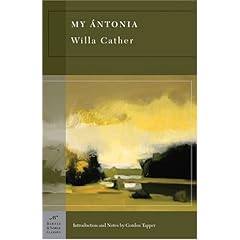
I enjoyed that it had very short chapters the perfect length for reading just before I fell asleep; that Ter had been reading it when she came to visit me in Italy; and that it was about a state where I lived, off and on, for half a decade, and brought back good memories. In addition to those recommendations, it was also an interesting story, and well-told.
I'd include some of my favorite quotes (one about how the primary feature of Nebraska, when one is driving through it, is that it keeps going, and the other about feeling attuned to the universe), but I ended up finishing it and racing it back to the library on my bike with just minutes to spare before it was overdue. So I guess they'll have to wait.

